

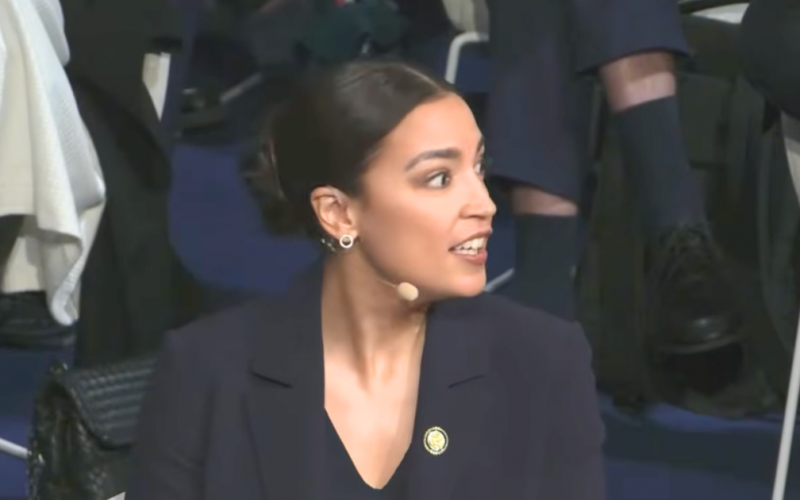
Rep. Alexandria Ocasio-Cortez (D-NY) struggled to deliver a clear answer when asked whether the U.S. should commit troops to defend Taiwan in the event of a Chinese invasion during the Munich Security Conference.
When pressed on whether the U.S. would and should send forces to defend Taiwan, Ocasio-Cortez began with a halting response.
“Um, you know, I think that I, uh, this is such a, you know, I think that this is a, um, this is of course, a, uh, very longstanding, um, policy of the United States,” she said before pivoting.
“And I think what we are hoping for is that we make sure we never get to that point,” she continued, adding that economic and diplomatic efforts should be used to avoid confrontation.
The exchange occurred during a panel in Germany that also featured Matthew Whitaker and Michigan Gov. Gretchen Whitmer (D).
Whitaker offered a more direct answer, stating that the president ultimately has authority over military deployments but emphasizing deterrence.
“Well, I mean obviously that would be the president’s prerogative as to how to deploy our military,” Whitaker said, adding that the U.S. must “deter and defend.”
Whitmer compared defending Taiwan to supporting Ukraine against Russia’s invasion, signaling that Taiwan’s security carries similar strategic weight.
Ocasio-Cortez’s hesitation comes as she attempts to expand her foreign policy profile amid speculation about a future presidential bid.
She has previously celebrated polling that showed her narrowly leading Vice President J.D. Vance in a hypothetical matchup.
During other portions of the conference, Ocasio-Cortez delivered more confident answers.
When asked about the possibility of U.S. strikes on Iranian nuclear facilities, she called such action “a dramatic escalation no one in the world wants to see.”
She argued there remains “so much runway” to pursue diplomatic solutions before considering military action.
On Israel, Ocasio-Cortez referenced the Leahy Laws and criticized unconditional U.S. aid, per the Daily Mail.
“The idea of completely unconditional aid no matter what one does, does not make sense,” she said, claiming U.S. policy “enabled a genocide in Gaza.”
She also framed global instability as rooted in economic inequality.
“Extreme levels of income inequality lead to social instability,” she said, warning that failure to deliver for working-class voters fuels authoritarian movements.
The Taiwan exchange, however, is likely to draw attention from critics who argue that clarity on defense commitments is essential amid rising tensions with China.
Taiwan remains one of the most sensitive flashpoints in global security, with Beijing repeatedly asserting claims over the self-governing island.
While Ocasio-Cortez emphasized prevention and diplomacy, she did not directly state whether she would support deploying U.S. troops if deterrence fails.
