

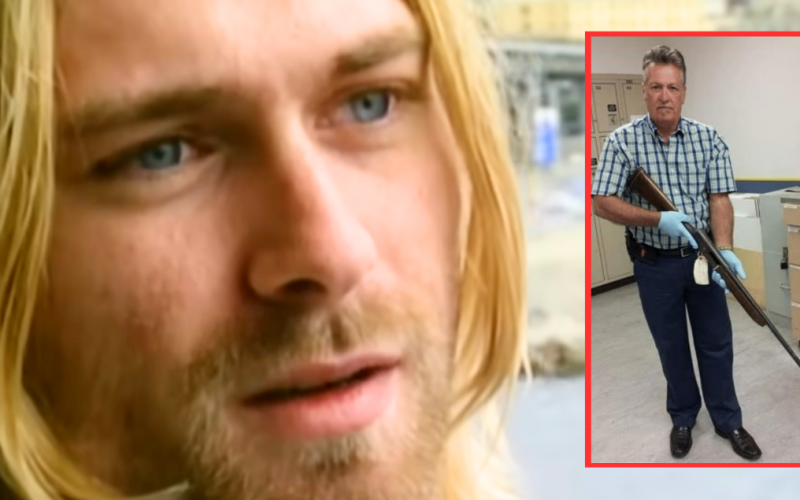
A team of private forensic scientists has released explosive findings challenging the official ruling on Kurt Cobain’s death.
They argue the Nirvana frontman was murdered rather than having taken his own life.
Cobain died on April 5, 1994, at age 27 from a shotgun wound at his Seattle home.
The King County Medical Examiner ruled his death a suicide by a Remington Model 11 20-gauge shotgun, according to reports.
The unofficial investigative team brought in Brian Burnett, a forensic specialist with experience in cases involving overdoses followed by gunshot trauma.
Independent researcher Michelle Wilkins worked alongside the team throughout the investigation, the Daily Mail outlined in a recent exclusive.
Wilkins reported that Burnett reached his conclusion after just three days of reviewing the evidence.
“This is a homicide. We’ve got to do something about this,” Burnett stated, according to Wilkins.
The team’s peer-reviewed paper presented ten points of evidence suggesting Cobain was confronted by assailants who forced a heroin overdose to incapacitate him.
The researchers claim someone then shot him in the head, placed the gun in his arms, and left behind a forged suicide note.
Wilkins pointed to specific findings in the autopsy that raised concerns. “There are things in the autopsy that go, well, wait, this person didn’t die very quickly of a gunshot blast,” she said.
The forensic analysis highlighted organ damage associated with oxygen deprivation. “The necrosis of the brain and liver happens in an overdose. It doesn’t happen in a shotgun death,” Wilkins explained.
Burnett has built a national reputation for his expert analysis in controversial cases. His work includes the death of Marine Colonel James Sabow and the investigation into Billey Joe Johnson Jr, where his forensic reconstructions challenged official findings.
The King County Medical Examiner’s Office responded to the new claims.
A spokesman stated the office conducted a full autopsy and followed all procedures in determining the manner of death as suicide, reported the Daily Mail.
The spokesman added the office remains open to revisiting conclusions if new evidence emerges. However, they have seen nothing warranting reopening the case and maintain their previous determination.
The Seattle Police Department also declined to reopen the investigation. A department spokesperson confirmed their detective concluded Cobain died by suicide, and this remains the department’s position.
Cobain’s autopsy described his body being found on the floor of the greenhouse above his garage. The June 20, 1994 autopsy documented various items found on his person.
Papers in Cobain’s left front pocket contained writing in black ink. The note read “Remington 20 gauge 2-3/4 shells or shorter setup light shot 10888925.”
Wilkins questioned the staged appearance of the scene. “To me, it looks like someone staged a movie and wanted you to be absolutely certain this was a suicide,” she said.
She noted the receipt for the gun was in his pocket, along with the receipt for the shells. The shells were lined up at his feet.
The forensic report observed that Cobain’s sleeves were rolled back. The heroin kit was found several feet away, containing capped syringes, cotton buds and pieces of black heroin of roughly equal size.
Wilkins challenged the plausibility of this arrangement. “We’re supposed to believe he capped the needles and put everything back in order after shooting up three times, because that’s what someone does while they’re dying,” she said.
Police investigators on the case said Cobain injected himself with ten times the normal amount even a heavy heroin user would consume. The Daily Mail noted that Cobain’s autopsy revealed fluid in the lungs, bleeding in the eyes, and damage to the brain and liver.
The forensic report argued these findings are unusual for a quick gunshot death but common in heroin overdose deaths. Such deaths cause slow breathing and low blood flow.
The eye bleeding and organ damage suggested his body may have been starved of oxygen. The team concluded this likely did not happen from the gunshot alone.
The autopsy did not mention blood being drawn into the airways, which often occurs in head gunshot deaths. While brain injuries can sometimes stop breathing, this usually happens shortly after trauma.
The autopsy report indicated his brainstem, which controls breathing, was likely not damaged.
His arm position also showed he did not have the rigid posturing usually seen with brainstem injury.
The forensic paper underwent peer review through the editorial process at the International Journal of Forensic Science before publication. Wilkins argued Cobain may have been physically incapacitated before the fatal gunshot.
She described his condition: “He’s dying of an overdose, and so he can barely breathe, his blood isn’t pumping very much.” This meant the brain and liver were not receiving oxygen and were deteriorating.
The size and mechanics of the gun raised questions about whether a comatose Cobain could have handled it. “If you look at the crime scene photos, you can see how big that gun is,” Wilkins said.
She questioned the physical possibility: “Imagine he’s comatose and dying, and also the way that he would have had to hold it… it’s six pounds.”
The placement of Cobain’s hands and the lack of blood spatter raised additional concerns. His left hand was tightly wrapped around the muzzle end of the gun’s barrel.
The shotgun shell was found on top of a pile of clothes opposite the expected ejection direction. The team replicated the weapon and found if a hand is on the forward barrel where Cobain’s hand was reported to be, the gun would not eject a shell at all.
Wilkins emphasized the unusual cleanliness of Cobain’s left hand. “If you ever look at photos of shotgun suicides, they are brutal. There is no universe where that hand is not covered in blood,” she said.
The report suggests Cobain’s left hand was placed on the weapon after death, explaining the thumbprint-like mark observed on his hand. Wilkins also cited blood patterns suggesting the body may have been moved.
She noted blood on the bottom of his shirt. “The only way the blood would get on his shirt is if Kurt was lifted and his head was down,” she stated.
The alleged suicide note came under scrutiny. “The top of the note is written by Kurt,” Wilkins said, adding there was nothing about suicide in that portion.
She described it as basically just him talking about quitting the band. The last four lines appeared different, with text that was bigger and more scrawly.
Wilkins emphasized the team seeks transparency and reexamination of evidence rather than immediate arrests. She has spoken to families whose loved ones took their lives because of Cobain’s suicide.
She referenced a recent case: “In 2022, a kid took his life because he believed Cobain did. The copycat suicides have never stopped.”
Requests to reopen the case have been declined by authorities, explained the Daily Mail.
Wilkins expressed frustration at the response, stating both agencies came back with refusals to examine the evidence.Her goal remains straightforward. “If we’re wrong, just prove it to us. That’s all we asked them to do,” Wilkins said.
