

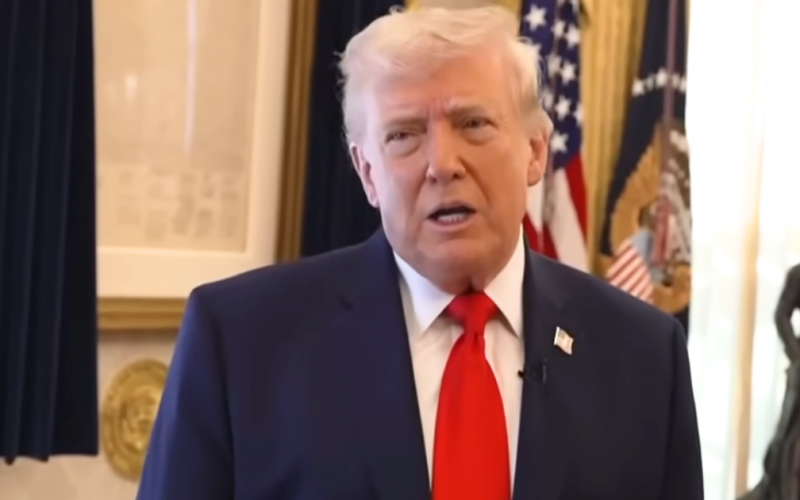
President Donald Trump outlined a firm new approach to federal immigration enforcement during an interview with NBC Nightly News anchor Tom Llamas that aired Wednesday, signaling that operations in Democrat-run “sanctuary cities” would generally proceed only if local leaders formally request federal assistance.
The remarks suggest a strategy designed to hold city officials accountable for rising crime while ensuring federal authority is respected.
Trump said that federal agencies, including Immigration and Customs Enforcement (ICE) and Customs and Border Protection, would no longer enter jurisdictions without explicit invitations from mayors or governors.
“They have to ask, and they have to say ‘please,’” Trump told Llamas, according to a transcript provided by The Gateway Pundit.
Sanctuary cities are jurisdictions that limit cooperation with federal immigration enforcement, often citing public trust and local policing priorities.
Such policies are in place in major cities, including Chicago, New York, San Francisco, and Philadelphia.
Critics argue these measures allow criminal illegal aliens to remain free, placing citizens at risk, while supporters claim the policies encourage cooperation within immigrant communities.
Trump framed the invitation-only model as a direct test of local leadership, suggesting that cities struggling with crime could see real improvement if they accept federal assistance.
He specifically referenced Chicago and San Francisco as examples where federal involvement, when invited, could reduce violence, pointing to prior operations that reportedly lowered crime rates.
The comments come after intense scrutiny of Operation Metro Surge, a major federal deployment to Minnesota late last year.
The operation became a flashpoint after protests erupted in Minneapolis and surrounding communities, fueled by allegations of federal overreach and the fatal shootings of two U.S. citizens during encounters with federal agents.
The controversy highlighted tensions between federal authority and local resistance.
In response to criticism, senior officials announced a partial withdrawal of federal personnel in Minneapolis.
Border czar Tom Homan confirmed hundreds of officers would be reassigned while maintaining that a substantial federal presence would remain to continue removing criminal illegal aliens.
Local officials continued to challenge the operation, asserting it exceeded federal authority.
Minnesota, along with Minneapolis and St. Paul, filed a lawsuit seeking to block the deployment, claiming constitutional violations tied to the scope of the operation.
A federal judge allowed the operation to continue, reinforcing the federal government’s right to act in jurisdictions that refuse to enforce immigration laws.
The broader dispute underscores a nationwide clash between federal authorities and sanctuary jurisdictions.
In 2025, the Department of Justice identified sanctuary states and cities, warning that these policies obstruct federal enforcement and endanger public safety.
The list largely included Democrat-led jurisdictions, many of which have seen rising crime in recent years.
Research on sanctuary policies remains contested.
Several studies show that crime rates in sanctuary jurisdictions are similar to or lower than comparable non-sanctuary areas, though federal officials argue these findings do not account for criminal illegal aliens released under local policies.
Conservatives point to these policies as evidence that sanctuary cities prioritize politics over citizen safety.
Trump’s comments signal a new era of accountability: local leaders must now decide whether to accept federal help or face the consequences of rising crime on their own.
By conditioning major interior enforcement operations on formal invitations, the policy could redefine federal–local relations and ensure cities that prioritize public safety receive support, while those that shelter criminal illegal immigrants are forced to confront the results.
WATCH:
