

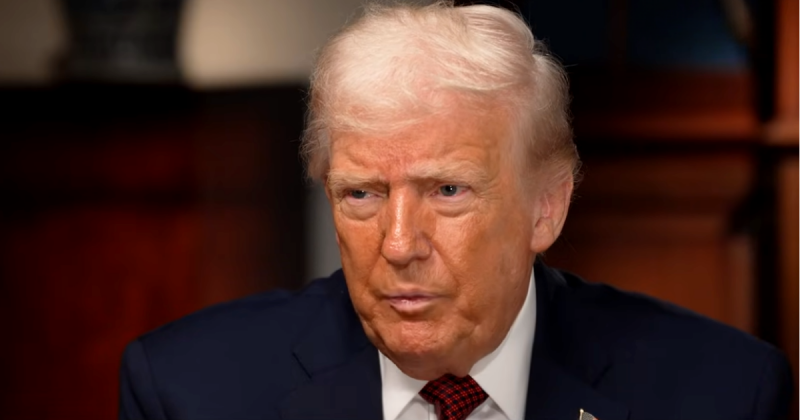
President Donald Trump is reigniting the national debate over election integrity, calling on Republicans to take a more active role in overseeing voting in key states and suggesting federal oversight might be necessary.
Speaking on former FBI Deputy Director Dan Bongino’s podcast, he said, “We should take over the voting in at least many—15 places. The Republicans ought to nationalize the voting.”
The remarks followed Director of National Intelligence Tulsi Gabbard observing the execution of an FBI search warrant in Fulton County, Georgia, where ballots from the 2020 election were seized.
While Democrats criticized the comments as an attempt to undermine state-run elections, GOP leaders emphasized the importance of securing the vote and ensuring confidence in the electoral process.
Senate Majority Leader John Thune (R-SD) voiced caution regarding federalizing elections, noting the strength of state-managed systems.
“I’m a big believer in decentralized and distributed power. And I think it’s harder to hack 50 election systems than it is to hack one,” Thune explained.
House Speaker Mike Johnson (R-LA) framed Trump’s comments as a response to inconsistent enforcement in some states, saying, “We need constant improvement on that front.”
Under the U.S. Constitution, states maintain authority over the “times, places, and manner” of elections.
Any attempt to nationalize election administration would require congressional approval and judicial scrutiny, USA Today noted.
White House press secretary Karoline Leavitt clarified that Trump’s statements align with the Safeguard American Voter Eligibility (SAVE) Act, legislation proposing stricter voter ID requirements, proof-of-citizenship verification, and limits on mail-in ballots.
Trump has consistently opposed unrestricted mail-in voting and advocated for voter-roll transparency.
The Justice Department, under Republican leadership, has pursued access to voter rolls in multiple Democratic-led states. Attorney General Pam Bondi described these efforts as essential to “bring back law and order,” according to The Independent.
Gabbard defended her presence during the Georgia operation, citing statutory authority under the National Security Act.
She emphasized the office’s role in protecting election integrity, writing on X, “Contrary to the blatantly false and slanderous accusations being made against me… the Office of the Director of National Intelligence has and will continue to take action under my statutory authorities to secure our nation and ensure the integrity of our elections.”
Democrats reacted strongly.
Virginia Sen. Mark Warner (D) warned, “This is frankly about what comes next,” while California Sen. Adam Schiff (D) urged the public to take Trump’s words seriously, framing the remarks as a threat to state election authority.
Senate Minority Leader Chuck Schumer (D-NY) described the proposal as a danger to democratic norms, claiming it could lead to a “one-party MAGA dictatorship.”
Conservatives argue that Trump’s focus is consistent with long-standing GOP priorities: verifying voter eligibility, enforcing ID requirements, and maintaining public confidence in elections.
Many point out that safeguarding the vote is not partisan but a necessary step to protect the integrity of the democratic process.
The ongoing debate highlights the tension between federal standards and state-run elections.
Supporters view Trump’s approach as a practical step to secure ballots and prevent fraud, while critics warn against federal overreach.
The discussion underscores the broader concern about election integrity, accountability, and ensuring public confidence in the American voting system.
WATCH:
