

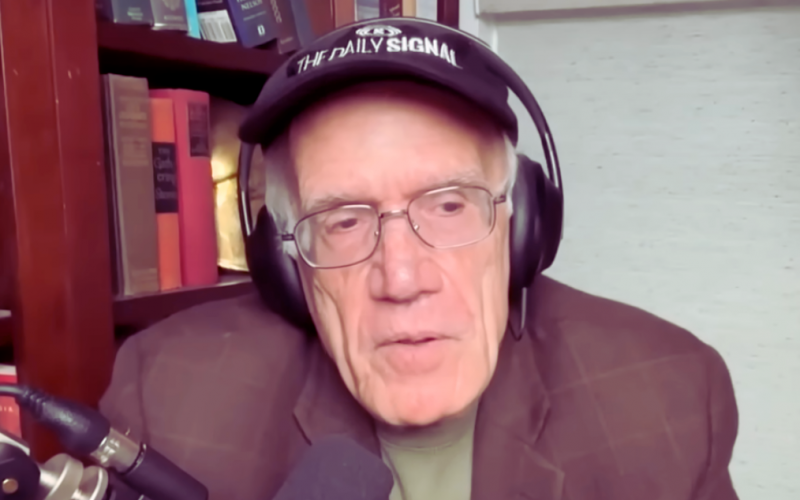
Hoover Institution Senior Fellow Victor Davis Hanson disclosed the full extent of his recent medical crisis in a detailed Monday post on X, revealing how a routine cancer surgery turned into a life-threatening emergency.
The prominent conservative scholar first informed his podcast audience on Dec. 26 that he would undergo an operation for a “serious” medical condition.
At that time, doctors had not yet diagnosed the specific nature of his illness.
Hanson underwent surgery on Dec. 30 to remove a cancerous lung mucinous adenoma carcinoma along with his lower right lung lobe.
Former Secretary of State Condoleezza Rice confirmed the operation date in a Jan. 3 post on X.
While the initial tumor removal was successful, Hanson experienced severe complications immediately following the procedure.
A post-operative aneurysm and bleeding developed soon after the surgery concluded.
The unexpected bleeding required emergency medical intervention.
Doctors rushed Hanson back into surgery for a second operation to stop the hemorrhaging.
The emergency procedure significantly extended Hanson’s time under anesthesia.
Medical staff administered approximately five blood transfusions during the life-saving operation.
The complications from both surgeries took a substantial toll on Hanson’s body over the following month.
He developed low red blood counts, persistent fatigue and episodes of arterial fibrillation.
These ongoing health challenges have considerably delayed his recovery process.
Hanson acknowledged that the combined effects of both operations have slowed his return to normal activities.
The type of cancer Hanson faced presents unique challenges for treatment.
The lung cancer variety affects nonsmokers and has a rare genetic mutation profile.
Medical data indicates this particular cancer type has a 40 percent recurrence rate in the general lung area.
This risk exists even when test results appear favorable, as in Hanson’s case.
All of Hanson’s removed and biopsied lymph nodes tested negative for cancer.
Adjacent vascular and pleural samples also came back clear of malignancy.
A pre-operative PET scan showed no signs of cancer outside the lower right lung lobe.
Despite these encouraging results, the significant recurrence risk remains a concern.
Treatment options for this rare tumor mutation are limited.
Chemotherapy and immunotherapy have not proven particularly effective against this specific cancer type. However, these preventative treatments can provide a five to ten percent advantage in stopping recurrence.
Hanson stated he will conduct a cost-benefit analysis to determine whether to begin these drug regimens.
His decision will depend largely on how quickly he regains his energy and strength.
The historian is weighing the potential benefits against the side effects of the treatments.
Hanson had previously disclosed some complications to former National Review publisher Jack Fowler in an email.
Fowler shared this information on X on Jan. 15, Resist the Mainstream previously outlined.
The health crisis began with what appeared to be routine illnesses.
Hanson struggled to recover from a bout with the flu in March 2025, followed by persistent sinus infections.
What doctors initially believed was pneumonia turned out to be the cancerous tumor.
Hanson referred to this misdiagnosis as a “pseudo-pneumonia.”
In his Monday post, Hanson expressed gratitude for the support he has received.
He thanked listeners and readers for their expressions of concern and reassurance.
The scholar addressed detailed questions and advice from his audience with the comprehensive medical update.
He wanted to provide transparency about his current temporary absence from public life.
Hanson remains optimistic about returning to his work.
He stated his hope to come back as soon as possible to his regular activities and commitments. However, he acknowledged uncertainty about the timeline for his recovery.
Hanson does not know exactly when he will return to near-normal functioning.
In the interim, he plans to post content periodically.
These posts will appear on days when he feels better and has sufficient energy to engage with his audience.
