

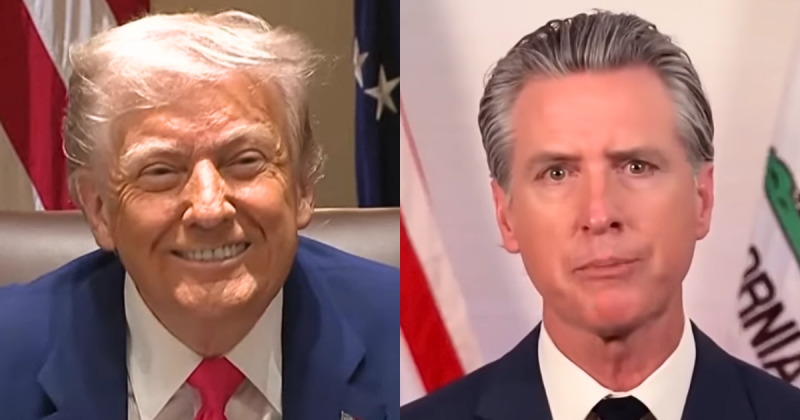
President Donald Trump has signed an executive order aimed at fast-tracking the rebuilding process in areas devastated by the January 2025 Los Angeles wildfires, particularly the Pacific Palisades and Eaton Canyon regions.
The fires destroyed nearly 40,000 acres and more than 13,000 homes, leaving tens of thousands displaced and many neighborhoods in ruins.
The executive order seeks to remove bureaucratic obstacles that have slowed reconstruction, allowing families, businesses, and houses of worship to return to normalcy more quickly.
The order directs the Federal Emergency Management Agency (FEMA) and the Small Business Administration (SBA) to implement regulations that preempt state and local permitting requirements.
Builders will be allowed to self-certify compliance with health, safety, and building standards to a federal designee, a move designed to overcome procedural delays that have hindered recovery.
Federal agencies are also tasked with using all available authority under environmental, historic preservation, and natural resource laws, including the National Environmental Policy Act, the Endangered Species Act, and the National Historic Preservation Act, to expedite necessary waivers, permits, and approvals.
Despite billions of federal dollars allocated for debris removal and disaster recovery, only about 2,500 of the tens of thousands of destroyed properties have received permits, and fewer than 10 homes have been rebuilt a year after the fires, RTT News reports.
Procedural bottlenecks, duplicative reviews, and inconsistent permitting standards have contributed to the slow pace of reconstruction, according to federal officials.
Permit fees, environmental reviews, and conflicting local regulations have added further delays and costs, prolonging hardship for fire survivors.
Gov. Gavin Newsom (D) and Los Angeles Mayor Karen Bass criticized the executive order as an overreach of federal authority.
Newsom urged the administration to approve California’s $33.9 billion disaster aid request, while Bass dismissed the order as a “meaningless political stunt” that fails to address the financial challenges survivors face, according to Politico.
Legal experts questioned the constitutionality of the order, citing the Tenth Amendment and longstanding precedent that land-use regulation is typically the responsibility of state and local governments.
Daniel Farber, faculty director at the Center for Law, Energy & the Environment at UC Berkeley Law, said the move is “completely unprecedented in terms of the history of federal disaster aid” and warned that it could face serious legal challenges in court.
Survivors of the fires have expressed frustration with permitting delays, but many highlighted financial barriers as the main obstacle.
According to The Independent, a survey conducted by the Department of Angels, a nonprofit supporting fire victims, found that nearly one-third of respondents identified rebuilding costs and insurance payouts as the primary challenges, while 21 percent cited permitting issues.
Joy Chen, executive director of the Eaton Fire Survivor’s Network, noted that while expedited permitting is helpful, funding and insurance remain the key challenges preventing many families from rebuilding.
The executive order also calls for a full audit of California’s nearly $3 billion in unspent Hazard Mitigation Grant Program funds, with federal agencies tasked to determine whether any allocations were awarded arbitrarily or contrary to law.
Draft regulations must be published within 30 days, with final approval expected within 90 days, signaling the administration’s intent to intervene where state and local governments have been slow to act.
While legal challenges are likely, the White House frames the order as part of a broader strategy to restore efficiency, accountability, and practical solutions to disaster recovery in California.
