

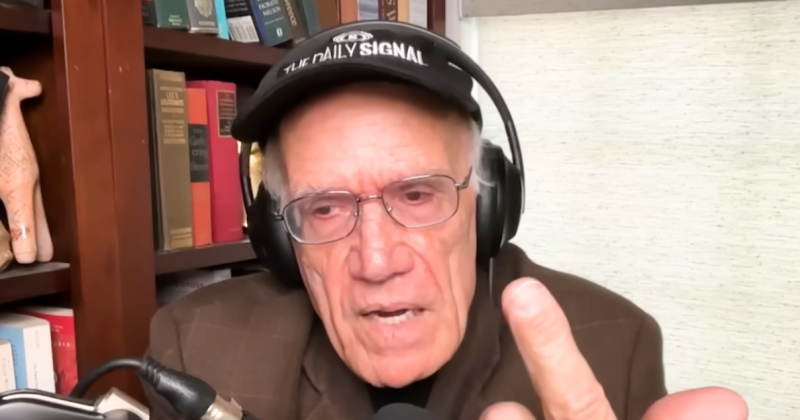
A prominent conservative intellectual narrowly escaped death earlier this month when a routine cancer operation took a dangerous turn, forcing medical teams to fight for his life in an emergency procedure.
Victor Davis Hanson, a senior fellow at the Hoover Institution, revealed through close friend Jack Fowler on Thursday that he survived a life-threatening arterial bleed following surgery to remove a cancerous tumor from his lung.
The 72-year-old scholar underwent the initial operation on Dec. 30 to excise the malignant growth that doctors had spent months trying to identify.
Medical professionals successfully removed the tumor during the planned procedure, but complications arose almost immediately in the recovery area.
Hanson experienced sudden hemorrhaging from an unidentified source while recovering from the first surgery, creating a critical medical emergency.
“The 12/30 cancer removal surgery a little more than two weeks ago went well. But as happens (I’m 72) sometimes, an arterial bleed of unknown origins developed in the recovery room. I was very lucky that the team got me back into surgery, found the hemorrhaging, provided numerous transfusions, and got me back to recovery,” Hanson said, according to Fowler.
The surgical team rushed him back into the operating room where they located the source of the bleeding and administered multiple blood transfusions to stabilize his condition.
The dual surgeries, combined with significant blood loss, left Hanson facing a lengthy recovery process with multiple complications to overcome.
“I am recovering well from the lung cancer surgery, but now mostly dealing with the after effects of the long time under anesthesia for the two procedures, blood loss, anemia, and some AFIB, which are all mostly manifested in fatigue and weakness,” Hanson continued.
The health crisis began months earlier when Hanson contracted influenza in March 2025 and found himself unable to fully recover from the illness.
He subsequently developed repeated sinus infections that persisted despite treatment, prompting concern among his physicians.
Over the following weeks and months, Hanson noticed progressive hoarseness in his voice and increasing physical weakness, symptoms that led to extensive medical testing.
The diagnostic process proved challenging because Hanson suffers from an uncommon variant of lung cancer that physicians sometimes call “pseudo-pneumonia” due to its deceptive appearance on medical imaging.
This rare form of the disease mimics inflammatory conditions on scans, making it difficult for doctors to distinguish from pneumonia and delaying accurate diagnosis.
Despite the severity of his diagnosis and the complications during surgery, Hanson received encouraging news from pathology reports following the procedure.
Analysis of lymph nodes and tissue samples extracted during the operation came back negative for malignancy, indicating the cancer had not spread to surrounding areas.
Additionally, a comprehensive body scan performed before the surgery showed no evidence of metastasis to other organs or regions of his body.
“There is much to be optimistic about, despite the nasty nature of this rare nonsmoker’s cancer and a few detours during recovery,” Hanson continued.
The scholar now faces ongoing challenges related to atrial fibrillation, anemia, and the cumulative effects of extended time under anesthesia during both surgical procedures.
Hanson remains focused on his recovery while managing the fatigue and physical weakness that continue to affect his daily activities.
