

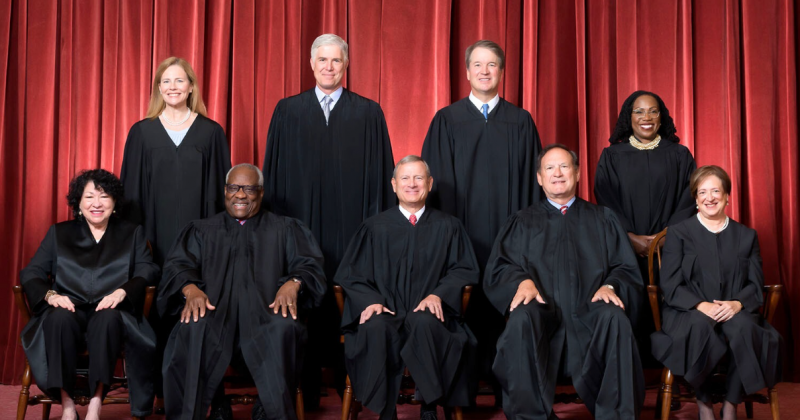
The Supreme Court heard oral arguments Tuesday in a case examining whether states may require student athletes to compete in school sports according to their biological sex at birth.
The dispute centers on laws enacted in Idaho and West Virginia that direct schools to separate athletic teams based on birth sex rather than later gender identification.
The laws are being challenged by students who identify as transgender and argue that the statutes violate the Constitution’s equal protection guarantees.
During the hearing, Justice Samuel Alito questioned Kathleen R. Hartnett, an attorney representing a so-called transgender Idaho student seeking to overturn that state’s law.
Alito first asked whether schools are permitted under the Constitution to maintain separate teams for boys and girls, Fox News outlined.
Hartnett responded that it is legally permissible for schools to have distinct boys’ and girls’ teams.
Building on that answer, Alito noted that such separation necessarily depends on defining who qualifies as a boy or a girl.
Alito then posed what he described as the central issue: “What is that definition for equal protection purposes?”
Hartnett replied, “Sorry, I misunderstood your question,” before offering a response that did not provide a clear legal definition of male or female.
She stated, “I think the underlying enactment, whatever it was, the policy, the law, we’d have to have an understanding of how the state or the government was understanding that term to figure out whether or not someone was excluded.”
Hartnett added, “We do not have a definition for the court… We’re not disputing the definition here.”
She further explained that the Idaho statute excludes males at birth from girls’ teams, while asserting that there is a subset of those males for whom exclusion would not make sense under the state’s own interests.
Alito continued to emphasize the need for a working legal definition, asking, “How can a court determine whether there’s discrimination on the basis of sex without knowing what sex means for equal protection purposes?”
Hartnett acknowledged that her client is considered a “birth-sex male” under the Idaho statute and is therefore barred from competing on a girls’ sports team.
She said, “So, we’re taking the statute’s definitions as we find them, and we don’t dispute them. We’re just trying to figure out, do they create an equal protection problem?”
Alito then introduced a hypothetical involving a male student who does not take puberty blockers or female hormones but states, “I am a woman. That’s who I am.”
Alito asked whether such a student could be barred from girls’ sports teams under the law.
Hartnett answered, “Yes.”
Alito followed up by asking whether that individual would be considered a woman under her understanding of the statute.
Hartnett replied that she would respect the student’s self-identity but said that the statutory question focuses on whether the individual has a biological, sex-based athletic advantage.
Alito responded, “What you seem to be saying is yes, it is permissible for the school to discriminate on the basis of transgender status.”
He then added, “If this person is a ‘trans woman,’ a ‘trans girl,’ and is barred from the girls’ team, then that person is being subjected to differential treatment based on transgender status, right?”
Hartnett’s exchange with Alito underscored the central legal conflict before the Court: whether transgender status constitutes a protected classification under equal protection law.
The case requires the justices to determine whether state laws separating athletic teams by birth sex violate constitutional protections.
The outcome could affect policies in multiple states that have adopted similar measures governing participation in school sports.
The Court has not yet issued a ruling, and a decision is expected later in the term.
