

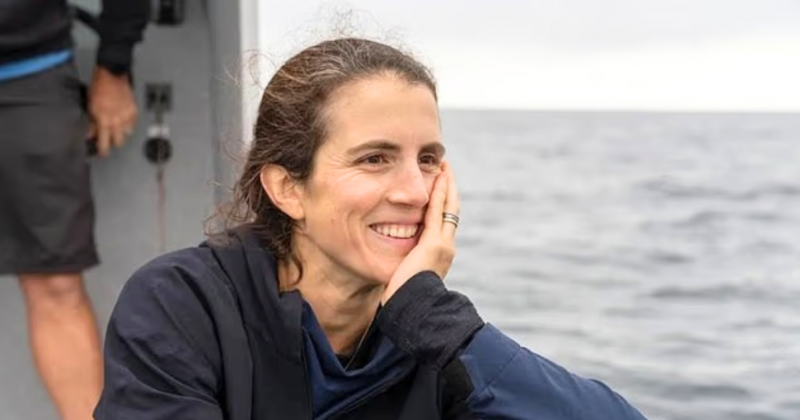
Tatiana Schlossberg, granddaughter of President John F. Kennedy and accomplished environmental journalist, died Tuesday morning at age 35 after a six-week battle with acute myeloid leukemia.
The JFK Library Foundation confirmed her passing in a statement released Tuesday.
Schlossberg is survived by her husband, George Moran, and two young children.
Schlossberg was the daughter of Caroline Kennedy, the former U.S. Ambassador to Japan and Australia, and Edwin Schlossberg.
She had established herself as a prominent voice in climate and environmental journalism, contributing to major publications throughout her career.
Her diagnosis became public knowledge just six weeks ago when she published a personal essay in the New Yorker in November.
The piece revealed she had been diagnosed with acute myeloid leukemia, an aggressive form of blood cancer, shortly after giving birth to her second child.
The cancer included a particularly dangerous characteristic called Inversion 3, a rare mutation associated with aggressive relapse patterns.
This genetic abnormality made her case especially challenging to treat.
In her November essay, Schlossberg described being blindsided by the diagnosis.
She had been extraordinarily healthy throughout her pregnancy, swimming a mile in the pool just one day before delivering her daughter in May 2024.
“I did not — could not — believe that they were talking about me,” Schlossberg wrote.
“I had swum a mile in the pool the day before, nine months pregnant. I wasn’t sick. I didn’t feel sick. I was actually one of the healthiest people I knew.”
The sudden shift from new mother to cancer patient required immediate and intensive medical intervention.
Schlossberg spent months hospitalized, undergoing multiple rounds of chemotherapy designed to combat the fast-moving disease.
Her treatment regimen included two bone marrow transplants.
One of the transplants came from her sister, who served as her donor in an attempt to give Schlossberg’s body the best chance at recovery.
Beyond standard treatments, Schlossberg participated in multiple clinical trials as doctors explored every available option to fight the aggressive cancer.
These experimental treatments represented cutting-edge approaches to a disease that typically affects much older patients.
During one of these clinical trials, her doctor delivered sobering news about her prognosis.
“During the latest clinical trial, my doctor told me that he could keep me alive for a year, maybe,” Schlossberg wrote in her essay.
Her immediate thoughts turned to her children and the fear they would grow up without memories of their mother.
“My first thought was that my kids, whose faces live permanently on the inside of my eyelids, wouldn’t remember me,” she wrote.
The essay detailed her husband’s dedication throughout her illness, describing how he took on every caregiving responsibility as she fought for her life.
It also explored her deep concern about her infant daughter, who might have no recollection of her as she grew older.
Schlossberg reflected on how her limited time had caused a flood of memories and emotions, transforming how she experienced each remaining moment with her family.
Her death adds another chapter of loss to the Kennedy family legacy.
The family has endured decades of public tragedy while remaining one of America’s most recognized political dynasties, still commanding attention more than 60 years after President Kennedy’s assassination.
