

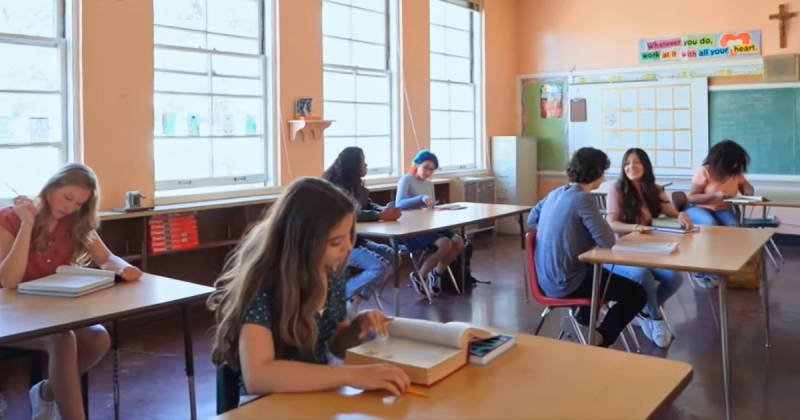
New York City’s statewide ban on smartphones in schools has been widely praised for improving classroom attention and student interaction, yet it has also revealed an unexpected educational gap: many students can no longer read traditional analog clocks.
Teachers report that pupils, who have largely relied on digital devices for timekeeping, struggle with a skill typically introduced in early elementary school.
Tiana Millen, assistant principal at Cardozo High School in Queens, described the problem as startling.
“That’s a major skill that they’re not used to at all,” she told Gothamist.
Since the ban took effect in September, students frequently ask, “Miss, what time is it?” demonstrating unfamiliarity with the “big hand” and “little hand” on a clock.
The policy, supported by Gov. Kathy Hochul (D) and the city’s teacher union, has noticeably altered school dynamics. Educators report livelier lunchrooms, more active recesses and faster hallway movement.
Students have embraced face-to-face games and activities, including board games, dominoes and cards, fostering both social skills and school spirit.
“We’ve had a lot more school spirit,” Rosalmi, a senior at New Heights Academy Charter School in Harlem, told New York Magazine. “People are more willing to participate in things they wouldn’t have before.”
English teacher Madi Mornhinweg highlighted the practical challenges in her classroom.
“It’s a source of frustration because everyone wants to know how many minutes are left in class … I started saying, ‘Where’s the big hand and where’s the little hand?” she told Gothamist, emphasizing a skill once taken for granted.
The Department of Education emphasized that analog time-telling is introduced in first and second grade. Students learn terms such as “o’clock,” “half-past” and “quarter-to” and are expected to become proficient on both digital and analog clocks.
“As our young people grow up in an increasingly digital world, no traditional time-reading skills should be left behind,” a spokesperson said.
Some students acknowledge the gap themselves. Fourteen-year-old Cheyenne Francis said classmates often forget how to read wall clocks due to constant phone use.
Fifteen-year-old Farzona Yakuba added, “I know how to read the clock if I really need to, but I feel like most students just get lazy and ask.”
Broken or mis-set classroom clocks have only worsened the issue.
This phenomenon is not unique to New York, The Independent notes.
A 2017 study in Oklahoma found only one in five children ages 6 to 12 could reliably read an analog clock, and schools in England began replacing analog clocks with digital models in 2018.
Experts say growing reliance on digital devices has gradually displaced traditional time-telling skills.
Despite these gaps, students’ digital literacy remains strong. Schools maintain advanced coding and robotics programs, and teachers often rely on students for technical guidance.
Mornhinweg recalled, “I was freaking out over opening a PDF, and my students calmly walked me through it. I felt really old.”
Educators see the trend as part of a broader shift in cognitive skill development.
Kris Perry, executive director of Children and Screens, said, “The question is whether this is a cognitive downgrade or just a replacement,” noting that handwriting and physical books stimulate more brain activity than screens.
As New York City navigates the first year of the smartphone ban, teachers and students are balancing modern digital skills with fundamental competencies.
While classroom engagement and in-person interaction have improved, educators caution that essential skills—like reading an analog clock—cannot be taken for granted in the digital age.
