

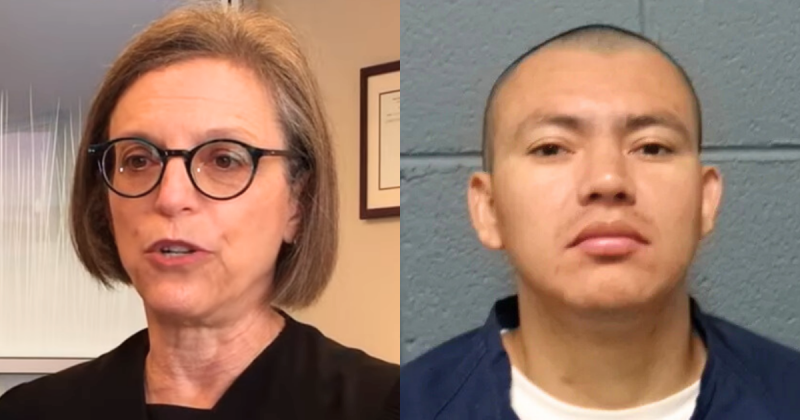
A federal judge in Michigan, appointed by former President Barack Obama, is facing widespread criticism after opting not to extend prison time for a repeat illegal alien convicted of sexually assaulting a disabled woman.
Her ruling, which included remarks on the defendant’s personal behavior, has sparked outrage from federal authorities, conservative commentators and local leaders, reigniting discussion over judicial discretion in immigration and violent crime cases.
Edys Renan Membreno Díaz, a Honduran national, had illegally entered the United States on at least seven occasions before committing his most serious offense.
In 2022, he admitted to raping and sodomizing a woman with cerebral palsy and cognitive delays in the laundry room of her apartment building.
Michigan state authorities sentenced him to 6–15 years for the assaults, The Washington Examiner reports.
Federal prosecutors recommended an additional 19 months in prison for Díaz’s repeated illegal entries.
U.S. District Judge Judith Levy rejected the request, determining that the five months Díaz had already served in federal custody, combined with his state sentence, was sufficient punishment.
Under her ruling, he could be eligible for release by July 2028 without serving further federal time.
At sentencing, Levy highlighted Díaz’s work history and the financial support he provided to his family, suggesting that his experience might deter others from attempting illegal entry.
She also noted that he had acknowledged his crimes and expressed remorse, framing her decision as an exercise of judicial judgment rather than a dismissal of the offenses’ severity.
Department of Homeland Security spokeswoman Tricia McLaughlin sharply criticized the decision, labeling it “unspeakable depravity.”
She clarified that the extra sentence sought by prosecutors applied solely to immigration violations and condemned the judge’s description of Díaz as an “ambassador,” which she said was inappropriate given the seriousness of his crimes.
The U.S. Attorney’s Office for the Eastern District of Michigan has appealed the ruling, asserting that Levy placed undue emphasis on Díaz’s repeated illegal crossings while downplaying the harm suffered by the victim.
Assistant U.S. Attorney Meghan Sweeney Bean called the sentencing “odd” and inconsistent with federal guidelines.
Officials emphasized that convictions for similar illegal reentry offenses typically result in sentences of roughly 19 months.
According to The Detroit News, prosecutors sought that time to run concurrently with Díaz’s state sentence, but Levy ruled that the time he had already served was adequate.
Kevin Kijewski, a Republican candidate for Michigan attorney general in 2026, denounced the ruling as “judicial activism prioritizing criminals over citizens.”
He called for stricter enforcement of immigration laws, stronger victim protections and tougher penalties for repeat offenders.
Levy’s defense argued that her decision was well within judicial discretion.
She noted that Díaz was already serving a substantial state prison term and had taken responsibility for his sexual assault, maintaining that additional federal time would have limited effect in deterring future illegal entries.
The case has attracted national attention, serving as a flashpoint in broader discussions about judicial authority and immigration enforcement.
Critics warn that leniency in such cases risks prioritizing perceived character over accountability, while supporters stress that judges must weigh individual circumstances and proportionality in sentencing.
