

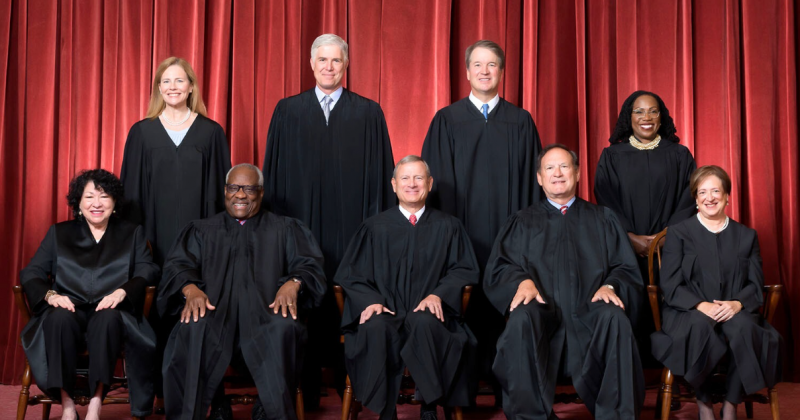
The Supreme Court delivered a significant win for Republicans on Thursday, permitting Texas to implement a newly drawn congressional district map for upcoming midterm elections despite legal challenges claiming the redistricting violated constitutional protections.
The high court’s conservative majority granted an emergency request submitted by Gov. Greg Abbott (R-TX), effectively halting a lower court decision that had blocked the map’s implementation.
The unsigned Supreme Court order indicated that Texas appeared “likely to succeed on the merits of its claim.”
The Supreme Court’s ruling suggested the lower court had “failed to honor the presumption of legislative good faith” when examining the state legislature’s intentions behind the redistricting effort.
The decision appeared to split along ideological lines, with what seemed to be a 6-3 vote and the court’s three liberal justices dissenting from the majority opinion.
Texas lawmakers designed the new congressional map with the potential to secure up to five additional Republican seats in the House of Representatives.
The redistricting effort comes as Republicans seek to maintain and expand their narrow majority in the chamber.
President Donald Trump scored a victory with the Supreme Court’s decision, having submitted a brief advocating for the justices to side with Texas in the dispute.
The nation’s highest court had temporarily frozen the lower court’s ruling on Nov. 21 while justices deliberated on their course of action, in an order bearing Justice Samuel Alito’s signature.
Under standard practice, states redraw congressional district boundaries once every ten years following the census, which tracks population changes across the country.
However, this year marked a departure from that established timeline, with Trump repeatedly encouraging Republican-controlled states to create new maps outside the normal redistricting cycle due to concerns about the slim Republican House majority.
Earlier this year, the Trump administration sent correspondence to Texas indicating the state risked federal legal action if it failed to eliminate “coalition districts” where nonwhite voters from different racial backgrounds form the majority.
A 2019 Supreme Court decision granted states the authority to redistrict with the explicit goal of maximizing the majority party’s political advantage. However, certain limitations remain in place under both the Constitution and the Voting Rights Act when racial considerations factor into the redistricting process.
Democratic lawmakers responded to the Texas redistricting initiative by launching their own effort in California to draw a new congressional map aimed at offsetting potential Republican gains from the Texas plan.
In the Texas legal challenge, a three-judge panel at the lower court level struck down the new map in a 2-1 decision.
Judge Jeffrey Brown, appointed to the bench by Trump, authored the majority opinion invalidating the redistricting plan.
NBC News reported that Brown’s opinion acknowledged that partisan political considerations influenced the redistricting process but concluded that “substantial evidence” demonstrated the map constituted a racial gerrymander that violated the Constitution’s 14th Amendment protections.
Texas attorneys argued to the Supreme Court that federal judges should not intervene at this advanced stage of the election cycle.
The legal team also contended that the new map clearly served partisan objectives and denied any racially motivated intent behind the redistricting.
“This summer, the Texas legislature did what legislatures do: politics,” Texas lawyers wrote in their submission to the court.
Six separate groups brought the lawsuit challenging the Texas map, including the League of United Latin American Citizens, known as LULAC, the Texas NAACP, and two Democratic members of Congress from Texas: Reps. Al Green and Jasmine Crockett.
Challengers argued in court documents that “the entire thrust of the governor’s justification for authorizing redistricting” centered on removing and replacing coalition districts.
